Upgrading Homes Without Losing Their Soul
SHARE THIS POST
Strategies for Enhancing Value While Preserving Classic Curb Appeal
As much as we love building new sustainable, high-performance homes, there’s one truth we can’t escape: the greenest building is the one that’s already built. The bones might be in decent shape, but it’s not uncommon to find houses that have been neglected, poorly renovated, or are filled with toxic materials behind the walls. That said, there are a number of ways we can give old buildings new life and make them perform just as well as a new house, which brings us to our current topic: deep energy retrofits. Not uncommon from some of the principles we use in our new build Passive House projects, these common sense strategies can make any old house a high-performing home.
What is a deep energy retrofit?
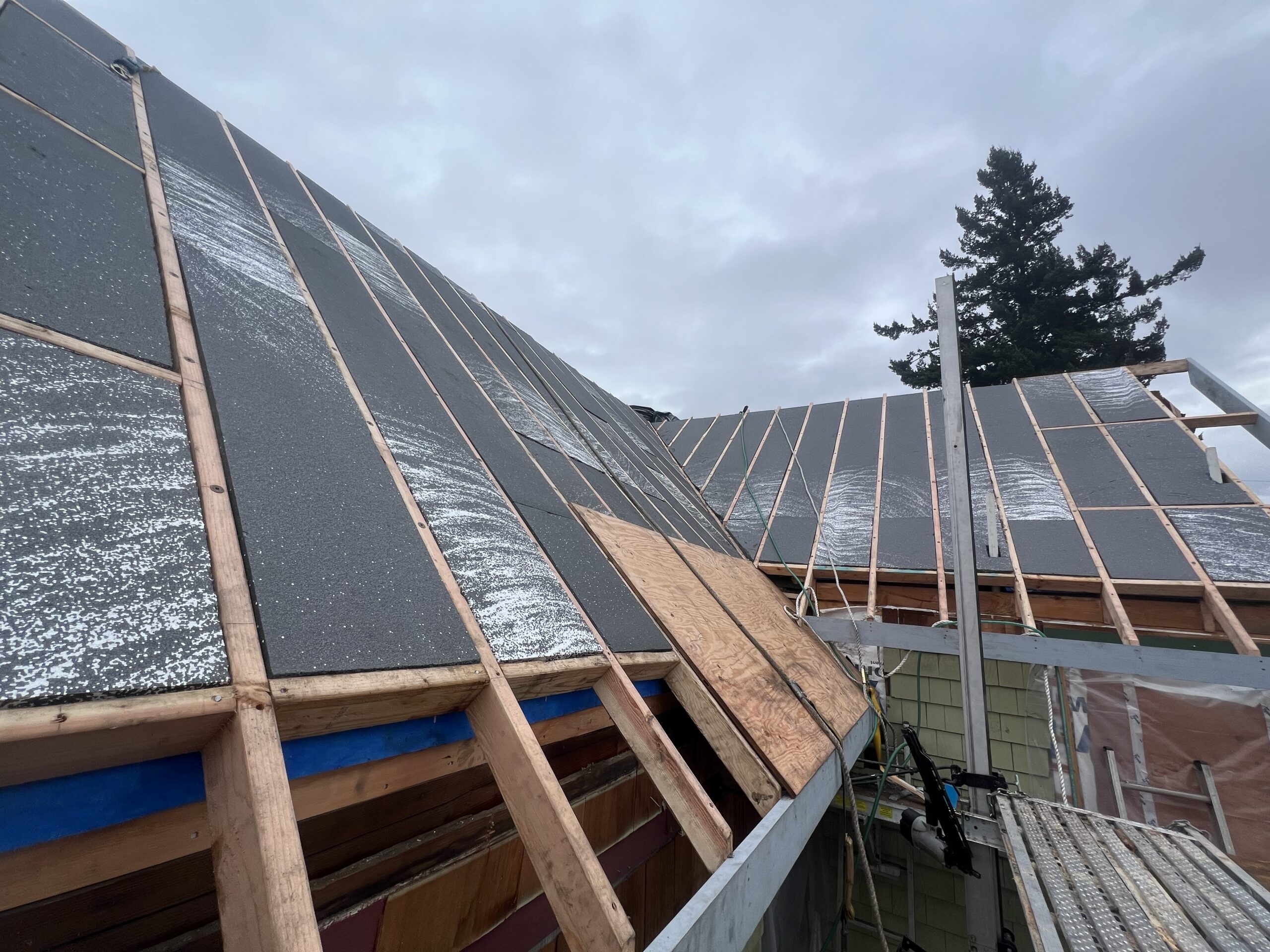
A deep energy retrofit is a whole-home upgrade that significantly reduces energy use through a combination of insulation, air-sealing, mechanical system improvements, and exterior upgrades. Instead of piecemeal fixes, it treats the home as an interconnected system, where every component works together to provide better comfort, efficiency, durability, and indoor air quality. Here’s a closer look at some key upgrades and how they interact with each other:
- Windows: No matter how tightly you seal the building envelope, it’s not much use if your energy is literally going out the window. Especially in older homes, single-pane windows are a major weak spot in the building’s energy performance. Once seen as a luxury upgrade, we’re starting to see more high-performance windows come to market giving homeowners more options, including double and triple-pane glass and insulated frames. In colder climates, the key is to use strategically placed windows with high solar heat gain coefficients (SHGC) on south-facing sides to let solar heat in, while using other methods like low SHGC windows, shading, and proper orientation for east and west-facing windows. These windows are specifically designed to maximize solar gain; that is, to prevent the home from overheating in the summer and stay warm during the winter. This, in turn, reduces the load on HVAC and other mechanical systems and ensures that those can work more efficiently.
- Air sealing: Despite their many charms, older homes often suffer from a lack of adequate air sealing. The culprits can be tricky to identify, and can be found in the walls, crawl spaces, attics, and anywhere in between. In a deep energy retrofit, we peel back the layers and root out the worst offenders, while new sealing products allow us fill in the smaller gaps that kill efficiency via “death by a thousand cuts.” One such product that we use is called AeroBarrier, which is a nontoxic sealant that’s blown into every nook and cranny using positive pressure and a blower door setup. The aerosolized sealant will find the cracks in the building envelope and will eventually accumulate on itself to seal the gaps.
- Energy recovery ventilation (ERV) systems: Buildings, just like living creatures, need to breathe. Older buildings do this naturally, whether it be through poor insulation, thermal bridges, or outdated windows. Now if we’ve solved the problem of drafts and insulation by sealing the envelope and installing new windows, we’ve created a new one: all that heat and moisture that’s generated inside the house needs somewhere to go. So in order to truly reap the benefits of those upgrades, a balanced energy recovery ventilation (ERV) system is critical. These systems not only circulate fresh air, but also pass the stale indoor air through an energy exchanger. The heat (or outgoing stale air) is then transferred with the incoming fresh air, recovering energy that would otherwise be lost. The opposite energy exchange can also be true in a cooling–dominated climate. In warmer climates, the stale cooler air will exchange cold energy with the incoming fresh warmer air.
What are the benefits of deep energy retrofits?
Deep energy retrofits go beyond simple fixes or catching up on deferred maintenance; they fundamentally improve how the entire building performs. Here are some of the key benefits:
- Lower energy costs: High-performance upgrades can come with a hefty price tag; they certainly aren’t the cheapest systems or materials. In the long run, however, those costs can be recouped through lower heating and cooling bills. When the house is performing as it was designed to, these systems greatly reduce the space conditioning load.
- Better indoor air quality: ERV systems work continuously to exchange stale air, which also regulates humidity and reduces contaminants. This, in turn, prevents mold and maintains a comfortable and safe moisture level throughout.
- Thermal comfort: With a tightly-sealed envelope and continuous insulation, drafts are almost completely eliminated. High-performance strategies dramatically reduce temperature variations through the house, which helps prevent condensation and cold corners.
- Less noise, more privacy: In addition to increasing energy-efficiency, an airtight envelope also naturally reduces outside noise, creating a noticeably quieter indoor environment.
- Increased home value and curb appeal: Today’s buyers are looking for homes that feel timeless in appearance yet deliver modern performance, making energy-efficient upgrades a smart investment from both a market and livability perspective.
Bellingham alone is home to eight districts on the National Register of Historic Places, and the historic nature of the homes in these areas is undoubtedly one of the main draws for homeowners. And with the benefits of a deep energy retrofit, these homes can be renovated not only to last another hundred years, but to feel as safe, clean, and comfortable as a newly-built home.